I was rewatching Major league yesterday and I was wondering what you guys think the stats of our main characters would have been? What do you guys think if you had to estimate.
Last year when I considered tragedy and the Hall of Fame I concluded that I would only consider players without a substantial career length if their peaks were well above their positions statistical benchmarks. When analyzing Buster Posey this cycle I argued his case falls well above the standard for a Hall of Famer. I can summarize Posey’s case in three points:
At his best Posey played at an above average Hall of Fame level, his 36.5 bWAR ranking 1.6 wins ahead of the standard at catcher. Baseball-Reference does not include framing, but the available data points to this skill increasing his lead over his peers
Posey racked up significant accolades winning an MVP, Rookie of the Year Award (one of only three catchers to do so), along with numerous other awards including two Fielding Bible Awards, a Gold Glove and Five Silver Sluggers.
Posey’s unique contributions in October, one of a handful of primary catchers leading their teams to three World Series championships.
I stand by my standards and my analysis of Buster Posey’s career. I do not think you can mathematically prove a player is, or is not, a Hall of Famer. But I firmly believe we as analysts should provide as consistent standards as possible when considering each player. My primary goal in analyzing careers is to preserve the quality of players inducted into the Hall of Fame. But: if I open the door to exceptions to my rule, in this case that a player should have substantial career length, then I need to define what this means.
There are some differences in career length for Posey compared to Pedroia and Wright. Pedroia and Wright played longer, about a full season’s worth of games, than Posey. But more importantly if tragedy is a lens through which I need to view a player, then I must also consider why Pedroia and Wright’s careers ended compared to Posey’s. Buster Posey chose to walk away from the game, despite being physically capable of continuing his career. Pedroia and Wright faced health problems which forced them into retirement. Tragedy is subjective, but electing retirement feels far less tragic than injury forcing retirement upon you. That does not change my bar, but I feel compelled to re-consider my work on this topic.
Precedent & Consistency
I wanted to answer two questions in my investigation:
Question 1: Are there comparable players in the Hall of Fame who Dustin Pedroia and David Wright compare favorably to? This does not mean simply that their peaks were better than some Hall of Famers, but are there other what I will call ‘peak first’ Hall of Famers like Pedroia and Wright?
Question 2: Are there many non-Hall of Fame players who are comparable to Pedroia and Wright who would merit serious consideration if we inducted them? Would applying a new standard result in supporting a significant number of new candidates?
I also will continue with the following assumption: if Dustin Pedroia and David Wright had played longer both would have earned induction into the Hall of Fame. Therefore, I do not want to compare them to players with longer careers. That would defeat the purpose of the exercise.
To answer the both questions I looked at players who had a career no longer than 20% longer than either Pedroia and Wright, with similar WAR and other achievements. I then looked at who falls in the Hall of Fame for both buckets and who falls out of the Hall of Fame with both buckets. My goal was to try to isolate players with similar career lengths.
Pedroia’s Best Precedent
Two Hall of Famers fell into Dustin Pedroia’s comparable list: Johnny Evers and Joe Gordon. I find these comparables fascinating in Pedroia’s case, consider:
All three second basemen won multiple World Series, and all three played a significant role in at least one of their World Series runs
All three second basemen won MVP Awards
All three provided positive value in every facet of the game
I find Johnny Evers a slightly less compelling comparison point for Pedroia since Evers played around the turn of the last century. Furthermore a lot of Evers’ case revolves around one of baseball’s most famous poems “Baseball’s Sad Lexicon” which described arguably the most famous double play combos in sports history: Joe Tinker-to-Johnny Evers-to-Frank Chance. Notably all three players earned induction into the Hall of Fame. Nothing comparable to that kind of fame exists in the modern game. Furthermore, while Johnny Evers was a solid hitter, he falls a little short of Joe Gordon and Dustin Pedroia in my book. Here are their career stat lines:
Evers played during Deadball, so the dearth in power should not surprise us, but even when placed in context Evers falls short of Pedroia and Gordon in power. He hit barely half the number of extra base hits that Joe Godon did, and little better than that compared to Pedroia. This despite playing the longest career of the trio. On a personal level: I would not have voted for Johnny Evers into the Hall of Fame either. While Johnny Evers was a great player, I think in context he falls short of Pedroia and Gordon. Both Gordon and Pedroia also faced challenges in their career that Evers did not. Gordon missed two full seasons due to World War II, and Pedroia’s health problems derailed his career. While Evers had some health struggles: none of them stopped him from playing like Pedroia’s. Therefore I conclude Johnny Evers’ career ended for less extraordinary reasons.
But Joe Gordon and Dustin Pedroia feel quite similar to me. Gordon was a feared hitter in the World Series. Hall of Fame manager Leo Durocher said the following before the 1941 World Series: “We’re not afraid of DiMaggio or Keller. The man we fear is Gordon.” Perhaps Leo foresaw the future: Gordon batted .500 in that series, the highest of any Yankee regular. 1941 was the third of five World Series championships he won in his career. This reminds me of Dustin Pedroia who tortured the Indians in the 2007 ALCS batting .345 in the series and he hit a home run which crushed my soul in Game 7 against Rafael Betancourt. The Red Sox went on to win the 2007 World Series, and won the 2013 World Series later in Dustin’s career.
We should also keep in mind: Joe Gordon’s career pre-dates the Gold Glove Award. Had the Gold Glove existed in the ‘30s and ‘40s: Gordon likely brings home some Gold Glove hardware. Gordon’s Hall of Fame plaque describes Joe as “an acrobatic second baseman” and his defensive numbers match his reputation.
So in Gordon we have similar players: MVP winners who won multiple World Series championships and combined strong defensive play with a potent bat. Gordon narrowly edges Pedroia in the hitting department. I would rate them comparably on defense, but Pedroia managed to bring in some extra value on the basepaths. Pedroia stole more bases, and succeeded more often. Overall: Pedroia actually produced more runs over his career than Gordon did. Taken all together: Pedroia and Gordon score comparably in JAWS. Gordon at 17th and Pedroia at 20th, with 3.7 WAR separating the two in JAWS.
If forced to pick: I would choose Gordon over Pedroia. In my view losing seasons while serving in World War II carries greater weight in my mind than losing seasons due to injury (even a contentious one like Pedroia’s). But not much separates the two players in my mind.
The Home Run Baker Benchmark
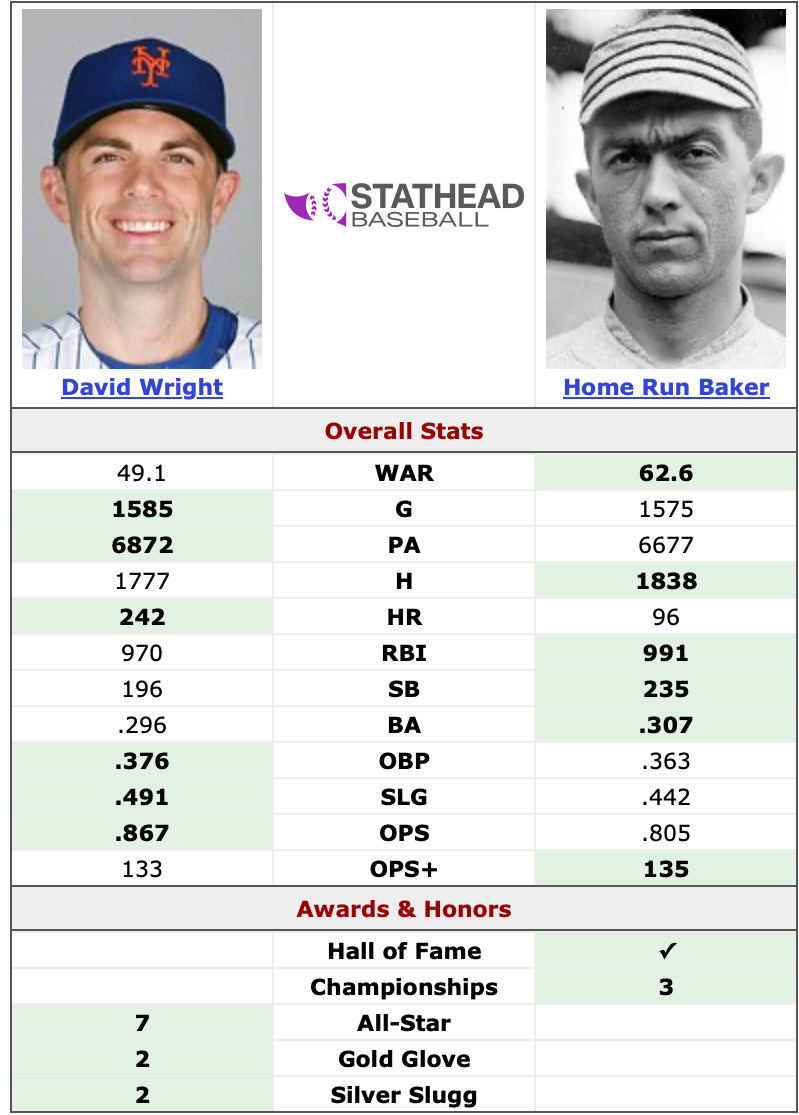
Unfortunately for David Wright only one Hall of Famer fits inside his sample: Home Run Baker. The two players bare some similarities, but I do not think this comparison helps Wright much:
By WAR: Baker trounces Wright. In fact, Home Run Baker’s WAR7 ranks 7th all time, enough to bring Baker above the Hall of Fame standard. What puzzled me was why Baker ranked so far ahead of Wright. Offensively their OPS+ is similar, with Baker only carrying a 2 point advantage, and Wright won two Gold GLoves and even stole some bases as a young man. So what separates them? Looking at it, a few key things:
While Wright and Baker were comparable hitters, Baker has a noticeable edge and Baker’s offensive achievements are more top heavy. In other words: when Baker was good he was better than Wright
Wright ranks as a slightly below average defensive third baseman for his career, while Baker ranks as a slightly above average defensive third baseman
Wright grounded into a fair number of double plays for his career, while we lack any double play data for Baker since his career pre-dates Major League Baseball capturing this data
There is a part of me that struggles to imagine that David Wright was that much worse of a defender than Baker; and when you look at two players with hitting statistics so comparable over such a similar amount of time: how can WAR really conclude that Baker was nearly 14 wins better than Wright? So I performed an analysis: how do they compare over their best seasons (their WAR7)? Well a year by year analysis shows that every one of Baker’s WAR7 seasons was better than Wright’s.
Baker also brings other advantages to the table. Baker won three World Series and batted .363/.396/.560 in the postseason - all in the World Series. In fact Baker’s .956 ranks 24th all-time with a minimum of 90 PAs. Given Baker played over 100 years ago it’s an impressive accomplishment. In contrast David Wright only played in October twice, and batted an anemic .198 in those runs. That is not Wright’s fault the Mets failed to make the postseason more often during his career. But Baker’s postseason accomplishments matter, and tip the scales further in his direction.
I considered other methodologies to see if I could narrow the gap between Baker. I looked at FanGraphs WAR to see if they viewed Baker and Wright differently. While their gap was a narrower 9 wins: they still held that Baker was the better defender of his career, although the offensive calculation flips in favor of Wright. If we dig deeper into the offensive calculations: Wright actually created more runs than Baker did over the course of his career (for more information on the Runs Created statistic invented by Bill James read this explainer) and feeling around the edges I think Wright has a case for the slightly better offensive player. But, in the end, every way I slice it I come to the same conclusion: Home Run Baker was simply a better player than Wright. The edge is consistent, and Home Run Baker’s peak ranks as top 10 or so all time for third basemen, while Wright’s falls short.
Pedroia’s Closest Non-Hall of Famers
In my view answering question one provided the best news for Dustin Pedroia. Dustin compares favorably to at least two other Hall of Famers (Joe Gordon and Johnny Evers). Looking at Question two I found seven second basemen who meet the following criteria:
Career lengths no greater than 8,000 PAs (a rounded estimate of 20% of Pedroia’s career length)
Played 66% of their PAs at Second Base
Career bWAR of at least 40
Not in the Hall of Fame
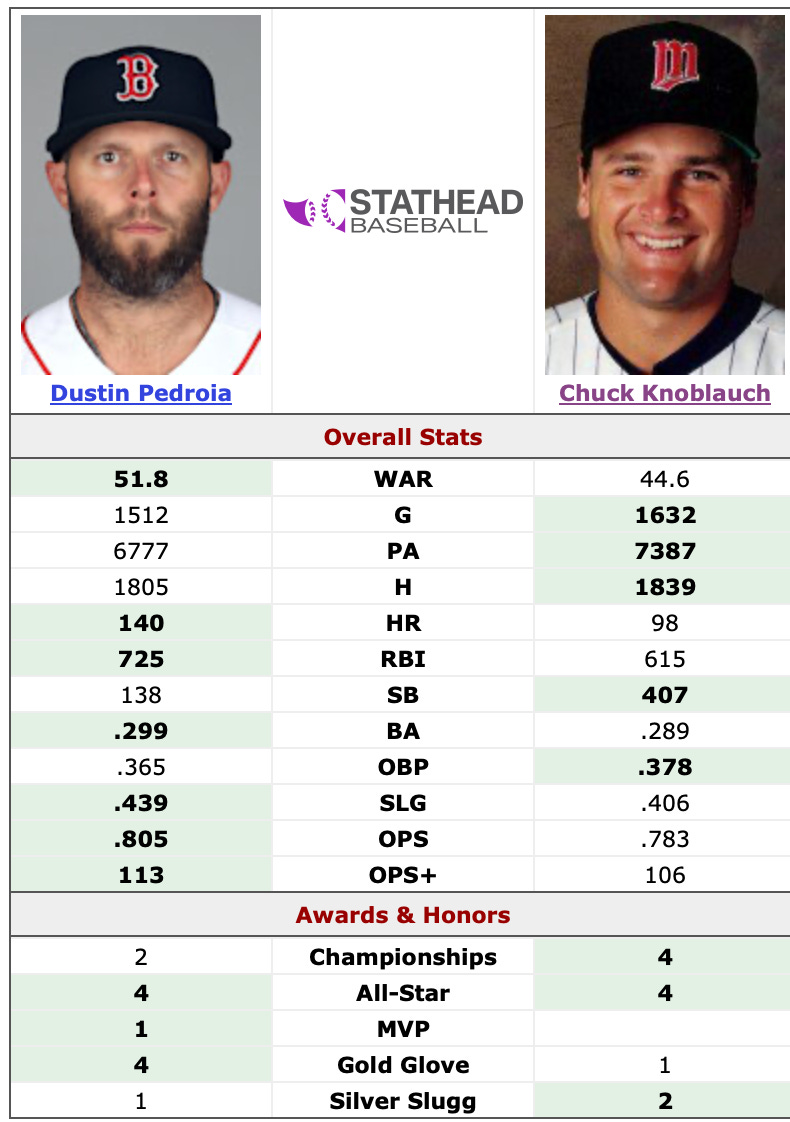
Those players are (in order of career bWAR): Chase Utley, Del Pratt, Larry Doyle, Chuck Knoblauch, Lonny Frey, Davey Lopes and Eddie Stanky. In this sample only two compared to Pedroia’s case: Chuck Knoblauch and Chase Utley. While Doye, Frey, Lopes, Pratt and Stanky have interesting cases in their own right, none in my view were good enough at their best to merit serious consideration and I graded them based on their WAR7 scores: all were at least 3 WAR less than Pedroia’s.
But Knoblauch and Utley are good comparables for Pedroia, most importantly because Chase Utley is well on his way towards Hall of Fame induction. I wrote about Chase Utley’s case last cycle. As for Knoblauch it’s an interesting comparison:
What sticks out to me in this comparison is Pedroia racked up more value in spite of playing fewer games. Chuck was underrated in his time, but Pedroia is the better hitter. But looking at this in many ways Knoblauch fits into the same mold as Eves, Gordon and Pedroia. Chuck only hit about as well as Evers but he too was a postseason hero, he did not win an MVP but he did win Rookie of the Year. Overall he provided a similar amount of peak value. On the back of Chuck’s regular season accomplishments he falls short of Pedroia, but I think Chuck’s contributions to four championship clubs (one in Minnesota and three in New York) is notable.
Overall, the good news for Pedroia is there’s only one serious comp for him, since Chase Utley will likely earn induction imminently, at his position that we would need to seriously reconsider for the Hall of Fame if we inducted him.
Wright’s Crowded Company
The inverse is true for David Wright. The affirmative case for Wright is weaker, and to make matters worse I found numerous players who compare favorably to David among third basemen. The sample for David Wright included players with:
A career no longer than 8,500 PAs (a rough estimate for 20% of Wright’s career length)
Played 66% of their PAs at 3B
Career bWAR of at least 38
Not in the Hall of Fame
Wright’s comparable list includes fourteen players. In order of career bWAR they are: Ken Boyer, Sal Bando, Evan Longoria, Robin Ventura, Ron Cey, Bob Elliott, Heinie Groh, Larry Gardner, Josh Donaldson, Matt Williams, Doug DeCinces, Harlond Clift, Carney Langford and Ryan Zimmerman. Of these players six have peaks of comparable value to Wright (within 3 WAR): Boyer, Bando, Longoria, Ventura, Cey, and Elliott with some of them ranking ahead of Wright. There is another factor which troubles me about Wright: not only are there several players with similar career lengths, and better peaks, than Wright; there are also several players with longer careers and better peaks than Wright outside the Hall of Fame. Buddy Bell and Graig Nettles rank ahead of David Wright in terms of career length and peak value and yet remain outside the Hall of Fame. They did not qualify for my list since they spent less than 66% of their time at third base, but all three rank ahead of Wright.
If Wright were inducted there is a long list of players, many of whom were arguably better than Wright, who would merit serious reconsideration.
Beyond Second and Third Base
Finally I looked at players who matched the following criteria at other positions as a final gut check to compare Pedroia and Wright to, to qualify a player had to have:
A career no longer than 8,500 PAs
Played 66% of their plate appearances at SS or CF (premium positions)
Career bWAR of at least 40
Not in the Hall of Fame
This sample includes 11 players, listed in order of career bWAR: Jim Edmonds, Chet Lemon, Cesar Cedeno, Fred Lynn, Jim Fregosi, Devon White, Troy Tulowitzki, Nomar Garciaparra, Lenny Dykstra, Curt Flood and Mark Belanger. This list contains numerous players who compare favorably to Pedroia and Wright. The most notable in my view is Jim Edmonds, a contemporary who fell off the ballot in one cycle. I wrote about Edmonds last year and argued that Edmonds belongs in the Hall of Fame. The other player who deserves a mention is Nomar Garciaparra. Like Pedroia and Wright: Garciaparra struggled with injuries and, at his best, played at a Hall of Fame level.
I did not compare Pedroia and Wright to first basemen and corner outfielders, but the list of players at non-premium defensive positions with strong peaks, but not long careers, is long. Don Mattingly has spent decades attempting to get into the Hall of Fame with no success.
Two Different No Votes
Any way you slice it I come to two conclusions:
Conclusion 1: David Wright’s Hall of Fame case clearly falls short of my methodology and benchmarks. There are not that many third baseman in the Hall like him, and the list of superior candidates outside the Hall is high (and this does not even include active players). There is no doubt in my mind that Wright was a special player at his best, but he is far from unique among special third basemen outside the Hall.
Conclusion 2: Dustin Pedroia’s Hall of Fame case is stronger than Wright’s, and carries a lot of weight. It’s not just the strength of Pedroia’s peak, but also the accolades he won and the postseason success he experienced. Pedroia would fit in with existing Hall of Famers, and not quite open the door to as many comparable players.
I do not regard either player as the strongest eligible, unenshrined candidate at his position. But we evaluate the ballot in front of us, not the ballot we wish we had. Both rank among my top 10 candidates on this ballot; that does not automatically make either worthy of a vote.
I am more firmly convinced that Wright falls short of my standard. I would place at least one contemporary ahead of him: Evan Longoria, whose longer career and stronger peak give him the better case. Wright was an exceptional player, but his combination of peak and career value does not sufficiently distinguish him from other third basemen outside Cooperstown.
Pedroia is the harder decision, but I remain a no. For a short-career candidate, I want a peak clearly above the Hall of Fame benchmark at his position. Pedroia’s 40.9 WAR7 falls short of the second base standard of 44.2. Pedroia comes close, and the Gordon comparison provides a legitimate precedent for supporting him. I nevertheless give Gordon the edge because of his stronger peak and the context of his two seasons lost to World War II service. That absence makes me more comfortable with Gordon’s limited career accumulation; it does not require assigning him hypothetical statistics.
Pedroia’s injuries explain why his career ended, and they make his case difficult. But his actual accomplishments still fall narrowly short of my standard.
I’ve wanted to make the trip out to the DR for some LIDOM games for a while now after seeing videos of how great the atmosphere, and I’ve decided this is the year I finally do it. I’ll be going in early January for the early playoff games, though the schedule isn’t finalized until the regular season ends in December.
To anyone who has made the trip before, any tips or advice or recommendations you can provide are appreciated. My friends and I want to make the most of it!
What would your team give up to acquire Bobby Witt Jr., Paul Skenes, and Mason Miller as a package deal? Bobby Witt Jr., Paul Skenes, and Mason Miller are three of MLB's rising stars with incredible talent. Hypothetically, let's say all three are available as a single package deal. You can't acquire them individually — it's all three or nothing. What would your team be willing to give up to acquire them? Cash, players, prospects, stadiums, team-owned facilities — anything goes.
Whenever somebody scores from first on a double, we usually get three different angles of the ball being hit into the gap.
I'd much rather see what the runner was doing.
How big was his lead? Did he read the ball correctly off the bat? How efficiently did he round second and third?
One of the things I enjoy about watching baseball in person is being able to follow a runner throughout an entire play. You realize pretty quickly that good baserunning involves considerably more than being fast.
We have all this technology to measure sprint speed and explain why a particular swing produced a home run, but broadcasts still do a relatively poor job of showing what makes someone a genuinely good baserunner.
Give me a replay following the runner from the moment the pitch is thrown. Especially on close plays at home.
Dios mio Diomedes Olivo! He was a left-handed Dominican pitcher who became one of the most dominant figures in Dominican baseball history before making his Major League Baseball debut at age 41.
I'm fascinated by those little overlaps in baseball history where two players you associate with completely different eras or franchises technically played together.
Baseball Reference already has a teammates tool, but I'd love to be able to sort those connections by the number of days the players actually shared a roster.
Imagine a veteran getting traded the same week a future Hall of Famer gets called up. They share a clubhouse for 48 hours and then spend the rest of their careers in completely different organizations.
There must be hundreds of bizarre connections like that buried in transaction logs.
What's your favorite example of two players who were teammates for such a brief period that it sounds wrong to even call them teammates?