My local food bank that I give to every year claims every $1 = 5 meals!
So $100 is 500 meals!
I don't question it because it is a good cause...but I kinda wanna know how that is possible for my own use. Probably major bulk buying power, charity discounts, etc. 🤔
Yes it's bulk buying power and also eating inexpensive foods without premium ingredients. I am nonwhite from a large immigrant family and have also worked in foodservice and it's the same thing. Scale, product management in a way that avoids waste, extremely good planning (purchase, storage, batch cook timing, organized storage afterwards, serving schedule and rotation), and selecting for extremely inexpensive ingredients - e.g. so much rice and beans. It IS possible to manage macros this way, you are just going to be finding some very cheap proteins and sourcing direct from local farms a lot if you want the fresh high quality stuff. There's lots of fresh produce just given away a moment before it spoils. If you have the time to do garde manger, you can wash, chop, and freeze fresh produce purchased or picked up free in bulk at the last instant before discard the same night and go a long way with it (you will need a chest freezer.)
Essentially it is a legitimate job qualification that is a significant task of people who work in foodservice, both front and back of house. You will not learn how to do it without at least several years of highly guided practice (some people learn from older female relatives, some learn on a job) and meticulously spelled out protocols such as printed job training materials or your grandma repeating her rules a couple hundred times, and you will get yelled at by the chef/corporate/your grandma every time you fuck up in those years.
A couple of years is probably underestimating it. Aside from standing in the kitchen with my aunts and grandma learning to cook since I was a toddler, one of my aunts owned a restaurant and two of my uncles owned a dry cleaners, so I've also been working since I was a kid, in the way that 8 year old sitting at the host stand of a family run Thai restaurant paused doing their homework to hand you the menus is working. Not literal child labor, but I did imprint on the rhythm of restaurant mechanics by childhood exposure. I also rode along with my uncle in the delivery truck when he picked up hotel linens in the summer, so I've been in the back doors of hotels and restaurants basically my whole life, even though I didn't really *really* work until I was 16. I then spent ages 16-32 in foodservice/hospitality full time, and about half time from 32-40 (while being full time in arts) and I'm now 43. So "it takes couple years" discounts the full lifetime immersion. I don't really know how long it will take you. I became actually good and fully qualified at inventory management type skills (in addition to other things) in my late twenties, typical terminal degree age. It helps if you're like, *really* into logistics. It requires the same personality traits that make people become engineers or large arena/stadium/public space managers. Autism, which I have, is a serious plus.
It's an achievable skill if you have a serious interest in it, and was a large part of how I was able to leave foodservice to go full time fine arts - I can bring my costs down to almost zero because I have a lot of hosptality management skills and am the kind of hippie that hates food waste, and waste in general, so i spend a lot of time doing procurement from an extremely complex series of sources. Because I'm just already that annoying person who tries to save shit from the landfill and other environmental harm; I can't help being that person so might as well reap the benefits of the shit I'm gonna be thinking about anyway.
It takes a lot of time to not spend money. You have to be someone who wants to spend the time doing it in lieu of working some other job, because it is a job. I just do it for myself now and not other people.
Usually it’s a rice/veggie mix in bulk. If you’re donating to Midwest food bank I can confirm as I’ve loaded around 500 of these bags before working with that charity. Very inexpensive per serving, easy to transport, and filling.
It also depends very heavily on a volunteer labor base. In which anyone and any skill level can participate.
I’m serious, any local food bank could probably use a couple hours of “pick that up and move it to here” type of labor. They very much can use “clean this disgusting grease” type of labor. If you want to do real help, call first and ask when you can volunteer and tell them you are very happy to do whatever they need.
Also school districts work through contract bidding, with at least 3 bidders needed for due diligence. So coming in under what most public services can offer is easy.
U haven't gotten a right answer yet. It's $ funding divided by meals produced.
Funding extra collection initiatives, transport, storage, etc.
Also how they calculate meals. 1 box cereal and 1l milk might count as 3 meals. IDK if there are standardized measurements where you are or what they are.
Food banks are able to buy food at quantities much larger than the typical person. The frequency and quantity of their orders unlocks discounted prices that the average American will never see or even come close to.
It’s like how buying in bulk tends to be cheaper, but on a supercharged scale. Sometimes even so much that it would be a loss to offer at the same price at the store.
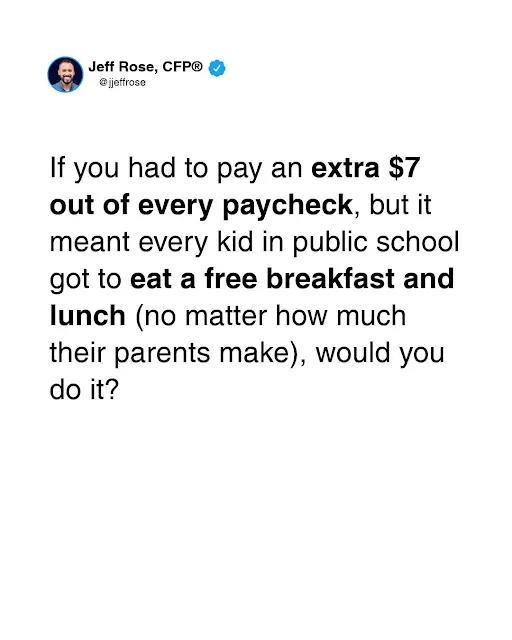
School lunch per child costs $5 per meal. So the return is a bit different. Not sure if it's any better of food (nutritionally speaking) than when i was in public school (it was trash then, definitely not worth $5). I've heard mixed reviews on that.
Well they get donations. Those are free. But they still need money to operate. That’s the way the math works in my head, anyways. I could be wrong and they are making like dirt cheap rice and bean meals.
The foodbank I donate to monthly gets a government matching grant and the food suppliers give them a big discount. In addition, several large corporations also give them a matching donation. I also donate monthly to a program that provides breakfast and lunch for schoolkids and they have a similar funding situation.
Even with the matching grants, corporate donations, and supplier discounts both programs struggle to feed everyone that needs feeding, especially these past few years.
Massive amounts of donations and bulk buying. And this is probably the best answer to any of this. Free food donated directly to the families, they make the kids food. If some of them don't feed their kids then that needs to be addressed.
View all comments
Show parent comment
55
u/kewe316 4h ago
My local food bank that I give to every year claims every $1 = 5 meals!
So $100 is 500 meals!
I don't question it because it is a good cause...but I kinda wanna know how that is possible for my own use. Probably major bulk buying power, charity discounts, etc. 🤔